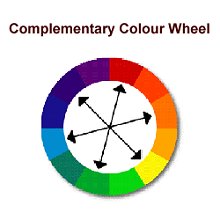
The colour wheel is used to explain the relationship between different colours and how new ones can be created. The three primary colours (those that cannot be made from other colours) are red, yellow, and blue. These are also sometimes called basic colours because they form the basis of all other colours. When we mix any two of the primary colours together, we create what is known as a secondary colour: orange (red + yellow), green (yellow + blue), and violet (blue + red).
|
|
|
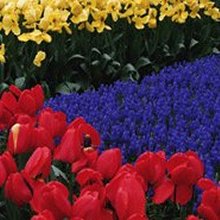
Colours that are positioned directly opposite each other on the wheel - orange and blue, for example - are known as complementary colours. As well as being placed across from each other on the wheel, these hues are also most opposite to each other in character. Adding white
to a particular colour, or hue, produces a tint. When black is added,
you have a shade. Tone refers to the degree of brightness.
|
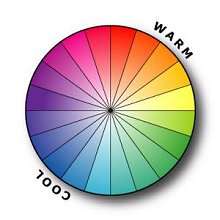
A hue's perceived "warmth" or "coolness" is another basic concept. Colours at the red to yellowish orange end of the spectrum create warmth, as well as appear to advance toward us. They have the strongest radiations and seem to be more capable of attracting our attention than others. Conversely,
colours at the bluish violet to greenish yellow end of the spectrum,
have weaker radiations, and they create a cool atmosphere, while appearing
to recede. |
|
Light VS Pigment Coloured light and coloured pigment are very different in the way they react when they are mixed together. The three primaries of light are red, green, and blue/violet, producing secondaries of yellow (red + green), turquoise (green + blue/violet), and magenta (red + blue/violet). If all three primaries of light are mixed together, the complete visible spectrum is assembled and white light results. However, where all three primaries of pigment coincide, black is formed. This is because each pigment reflects only the wavelengths of light corresponding to its own colour, and subtracts all the others. |
|
Katy Kianush
April 2005
|
Top of page |
Copyright shall at all times remain vested in the Author. No part of the work shall be used, reproduced, stored in a retrieval system, or transmitted in any form or by any means electronic, mechanical, photocopying, recording or otherwise, without the Author's express written consent.
Copyright © 2005 K. Kianush, Art Arena